BLOG
What “AI-Ready” Actually Means for Marketing and CRM Teams

Moving Beyond AI Features to Operational Readiness
AI has quickly become a standard feature across CRM and marketing automation platforms. Predictive lead scoring, automated content generation, and churn forecasting are more powerful than ever. Yet, many organisations are discovering a gap between having AI-enabled platforms and generating measurable impact.
At Social Garden, we’ve seen that AI success doesn’t begin with turning on new features, it begins with readiness. Being “AI-ready” means your organisation, your data, and your processes are structured to allow AI to operate effectively, responsibly, and at scale.
1. Organisational Readiness: Alignment Before Automation
AI does not replace strategy; it accelerates it. Before deploying AI across your tech stack, teams must align on three foundational elements:
- Clear Commercial Objectives: AI initiatives must be tied to defined outcomes, such as increasing MQL-to-SQL conversion, improving sales response times, or reducing churn. Without a goal, AI is just experimentation without direction.
- Defined Ownership and Governance: AI touches marketing, sales, IT, and compliance. AI-ready organisations define who owns lifecycle definitions and establish governance around AI-driven decisions to build internal trust.
- Executive Commitment: AI requires upfront investment in data cleansing and process redesign before visible returns are achieved. Leadership must view AI as an operational capability, not a one-off campaign tactic.
2. Data Readiness: The Non-Negotiable Foundation
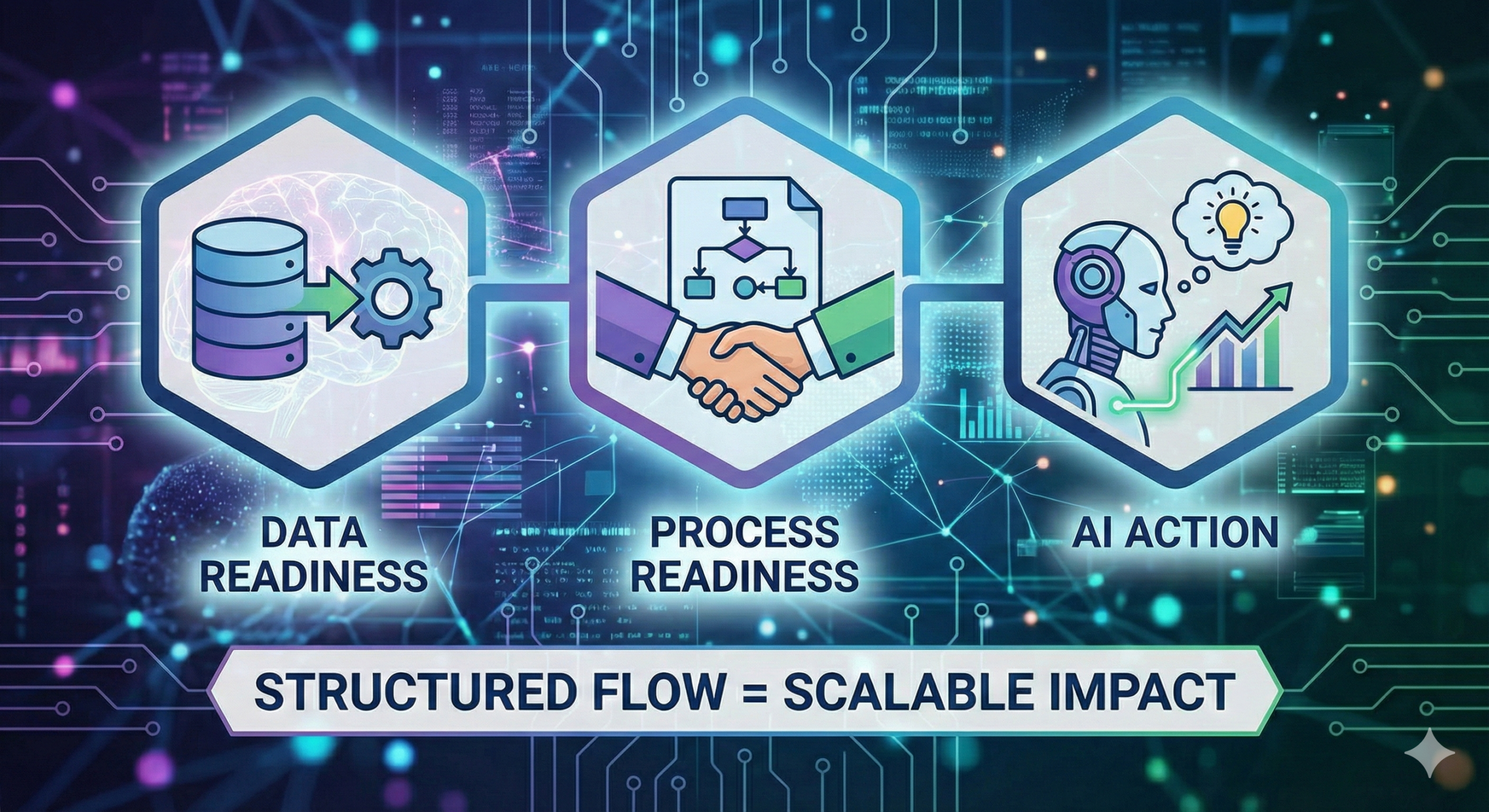
A “smart” CRM is only as intelligent as the data inside it. AI amplifies existing patterns; if your data is inconsistent, AI will simply scale those inconsistencies. Readiness requires a disciplined data framework:
- Standardised Lifecycle Stages: If Marketing and Sales define stages differently, predictive scoring becomes unreliable. Teams must agree on clear definitions and entry/exit criteria for MQLs, SQLs, and Opportunities.
- Structured Data Capture: AI depends on consistent inputs. Best-practice data should be categorised into four buckets:
- Mandatory:Core identifiers (Name, contact details).
- Intent: Buying signals (Budget, timeline).
- Preference:Product or service alignment.
- Profile: Firmographic or demographic qualifiers.
- Unified Customer View: Ensure consistent data tracking at every milestone to improve sales forecasting.
3. Process Readiness: Turning Insights into Action
Even the most accurate predictions are ineffective without defined workflows. AI-readiness means your organisation is prepared to act on AI outputs consistently:
- Workflows for AI Signals: Every AI output (like a churn risk alert or a high-intent score) must connect to a process: Who responds? In what timeframe? Through which channel?
- Testing and Validation: AI models are probabilistic, not perfect. Ready organisations implement ongoing A/B testing and regular refinement of automation logic to ensure the “machine” stays on track.
- The Feedback Loop: AI improves when outcome data feeds back into the model. This requires frontline teams to maintain CRM hygiene—if Sales neglects to log why a deal was lost, the AI’s intelligence degrades over time.
4. Governance and Risk Management: Responsible AI
Finally, AI introduces operational and compliance considerations. Marketing and CRM teams must establish guardrails around data privacy, bias in predictive models, and human approval thresholds.
For example, deciding which AI-generated communications require a “human-in-the-loop” review is a critical step in maintaining brand integrity and regulatory compliance.
Wrapping It Up
Think of AI as a force multiplier. It multiplies what already exists:
- Clean data becomes actionable insight.
- Strong processes become scalable automation.
- Aligned teams become high-performing growth engines.
Without these foundations, AI becomes another underutilised feature in an already crowded tech stack. At Social Garden, we approach AI as an operational capability built on structured data and clearly mapped workflows.
Whether you are looking to leverage AI within Salesforce Sales Cloud, orchestrate complex journeys in Marketing Cloud, or scale your impact as a HubSpot or Microsoft Dynamics 365 user, the principles remain the same. When your platform and your strategy are aligned, AI shifts from being a simple tool to a genuine competitive advantage.
👉 Ready to assess your organisation’s AI readiness? Let’s build the foundations that allow AI to truly perform. Talk to us today.
contributors